

What the FTF?! Winners, losers, and learnings
A packed month of elections, earnings, rate decisions, and the UK Budget has flipped markets from risk-on to cautious, with a sharp tech sell-off, widening credit spreads and likely rate hikes in the UK, eurozone and US all pointing cash and treasury teams towards protecting what they have.

Without a doubt, the busiest month of the year. Elections, corporate earnings (that finally matter), rate announcements, and policy adjustments, all on top of what was already a news-heavy four weeks. We have sadly seen pockets of significant unrest, not just in France but several European countries. For now, at least, de-escalation in the Middle East, until it isn't. The markets have also pivoted with regard to risk appetite. In just a few short weeks, the narrative has shifted from all news being good news to even some good news being bad. Confused? Read on…
Macro
One of the best pieces of news of late has been the rise in participation rates at the polls. No matter the outcome, a healthy democratic system is the best we have come up with, and its proper functioning is a prerequisite for a stable and fair society. This remains of particular importance as various countries grapple with unrest, dissatisfaction, and a desire for change. In terms of trends, the most apparent is the further polarisation of the electorate, which can and will likely lead to more extreme outcomes. The challenge faced across much of the world remains not just inflation. Whilst everybody gets one vote, the outcome and winners vary vastly.
Global youth unemployment continues to rise and has actually been felt the sharpest in the most “developed” countries (International Labour Organisation). Part of this particular conundrum has of course been AI. Just four weeks ago, the market was a flurry of activity, with announcements of mega-raises and record highs. There is one number that really brings this point to life: tech stocks alone have lost $5 trillion of market cap in under a month. Now thankfully we have seen much of the rest of the market perform, and well, following all the various earnings releases that will be covered in more detail a little later. The big question that I am often asked, though, is whether we have seen the top of the market. To me at least, it is hard to see where a rally may come from.
We now have a Democrat House and Senate in the US, making decisions and action harder, we have continued unrest in much of Europe, and, whilst for now there seems to be a lull in conflict, the next aggravation and escalation feels more plausible than not. Inflation remains high and sticky, as does the cost for governments to borrow, whilst borrowing more. Oil, which let’s face it, we remain dependent on for the lives we lead, remaining above $100 and flirting with all-time highs is not helpful. As a believer in free markets and capitalism (+ welfare for those that can’t) being the best system we have come up with in human history thus far, it is not without some pain that we have seen the largest oil producers and traders doubling, tripling, or more their quarterly earnings (The New York Times). This, coupled with the fact that Gulf Arab oil companies’ exports are back at pre-war levels, is a somewhat bitter pill for much of the global populace (Bloomberg).
Much like the rest of the backdrop and the ongoing elections, it feels like we are closer than we have been for some time at a point of inflection where winners and losers are being chosen, or just sometimes, forced upon us.
Risk
Everything was a buy! Now it's a case of what not to sell. The market has spoken, and the latest quarterly tech earnings have (finally?) disappointed. Monetisation and spending are the driving factors, now apparently important again. Anecdotal conversations have pointed to more and riskier lending as standards slipped with folks wanting a slice of the action, giving up more to receive less with what seems like an unquenchable thirst for cash from those building in the space. Thankfully, for now, any damage will remain contained, hence the lack of a broader, and thus more violent, sell-off ensuing. Intel’s earnings miss and rapid sell-off are a stark reminder for us all that things can move far faster than we can both imagine and manage. Again, numbers are our friend. Not only had the stock sunk 29% on Friday, but this on top of an already 16% decline over the month of October, bringing the cumulative to almost a halving.
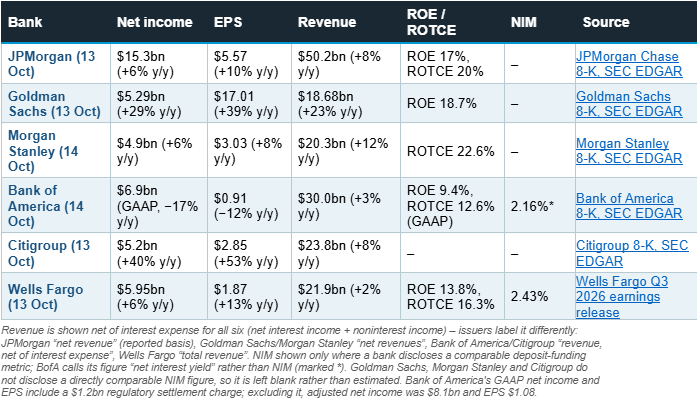
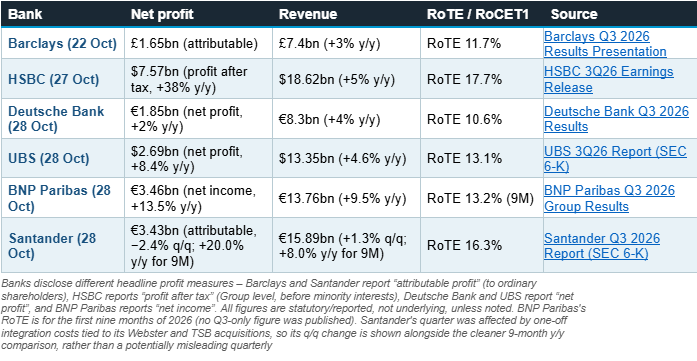
Outperformance has thus far come from the banking sector, with tables at the end for those curious to see the stack in more detail. Dealmaking and IPO activity have done well in generating significant fee revenue. It is good to see further momentum in these markets, ending the freeze. This had been anticipated for 2026 as expectations of both buyers and sellers have narrowed and fundraising/dry powder as well as vintages for funds that were now headed towards the end of their lives have looked to sell. What was not expected was the initial impact of AI and the SaaSpocalypse, nor the volatility off the back of conflict. Banks and hedge funds LOVE volatility. A silver lining of sorts!
More broadly though, the spread between the winners and losers on a country-by-country basis is increasingly apparent. With less than two months to go, the frothy start to the year is looking a little less exciting. The three major indices in the US (being the Dow Jones, S&P 500, and NASDAQ) all hovering around high single-digit returns, Brazil erasing 25% plus of annual gains since we last put pen to paper, putting them close to flat year-to-date and France’s CAC 40 now sitting in the red (albeit marginally), all paint a very different picture, even from one month ago. The big outperformer, clinging to the gains amassed earlier in the year, remains the NIKKEI in Tokyo, up a solid 25%. Whilst some smaller Asian indices have held on to some 50%+ gains, not to be disrespectful here, but they boil down to a few single-name stocks that have an outsized impact on index performance and are all tracking that same AI/semiconductor story.
Credit
Higher for longer makes all cash strategies that much more important. What we are also starting to see is some of the false assumptions of lower sooner beginning to play out. Elevated rates are bad for borrowers, and the longer it continues, the more impactful it becomes. This is certainly starting to play out in markets. There has been a significant widening of spreads in the high-yield market in the last couple of months. To put it differently, the least creditworthy are having to pay more not just on an outright or nominal basis, but also versus those with stronger balance sheets and more durable and predictable cash flows, where the means to cover interest is also more favourable. The premium paid by this “high yield” cohort has risen by 0.5% all else being equal, from 261 basis points to 311. For now, those in the investment grade bucket have hardly seen a move. Stress in private credit, the most opaque of markets, puts defaults at a record 6.3% for August (OCBC). We are keeping an eye on the latest reporting, which we will continue to share. The question is… will the widening seen in high yield seep into investment grade?
Primary markets are very much open for business, so there remains good data on how and where investors are placing their bets and pricing risk. Globally, risk-off sentiment also stands true, driven in part by the equity selloff and geopolitical tensions. Credit default swaps (or the price to insure against default) have been pushing higher. Some notable moves have been the French banks widening twice as fast as the rest of the stack (Bloomberg, BANK), driven by the deterioration of sentiment given the political situation. Away from this, the hyperscalers and chipmakers once again make the headlines, with widening to record levels (International Financial Review). These are not the records you want to be breaking.
EUR
The ECB held rates at 2.50% on October 29 in line with expectations. What was not expected was that ECB President Lagarde would step down early at the beginning of February. For anyone wondering if this really has any impact, just look at recent US history. According to the market, at least, the ECB is set to hike in December with an 89% chance of a 0.25% hike. What has dropped significantly, though, is the terminal rate, previously expected to hit almost 3.50% next September, bets now curtailed to the very same month but now at a meagre 3.09% (data from Bloomberg; WIRP).
The market is also telling us something by way of the bond market. Spread widening has not just been reserved for the high yield borrowers. German 10Y yields fell roughly in line, while French yields rose a further 25bp or so. The OAT-Bund spread has now widened to roughly 160bp, meaning a premium of 1.6% for France to borrow the same amount for the same time period. (Bloomberg, 11/02/2026). In percentage terms, at almost 50% higher, this is starting to feel rather significant. We do, at least, remain well off the highs of the previous European sovereign crisis (yes, there really was one between 2010-2012!). Spreads continue to be monitored closely here. The root cause is a familiar one. Tough and painful decisions need to be made to balance the books. We are often not paid to be popular, rather to make the hard decisions. This would be one of those moments for those leading the various public institutions. If we were to seek inspiration from a recent example of how this can be done, look no further than Greece over the last 15 years.
September's final CPI print (3.8%) confirmed the flash estimate. Energy prices (+18.8% y/y) did all the work, so this was a non-event for pricing.(Eurostat, 16 Oct. France's Q3 GDP contracted −0.1% q/q, the only major euro-area economy to shrink, against Germany's +0.2%, underscoring the fiscal-stress narrative in Macro. Euro-area GDP as a whole rose 0.4% q/q (flash, 30 Oct), down from 0.6% in Q2. (Eurostat, 30 Oct 2026). Eurozone unemployment ticked up to 6.5% in September (from 6.4% in August), still a touch above the 6.3% reading a year ago. (Eurostat, via JM Financial Services, 30 Oct 2026)
GBP
UK money markets now price ~96% odds of a 5 November hike to 4.00% (little changed from ~96% on 26 Oct, and up from ~87% on 24 Sep) – still the most hawkish repricing of the three currencies, though the move itself has largely stabilised.
Looking at the underlying data driving those tough decisions at the Bank of England, September CPI came in hot at 3.5% year-on-year (core inflation at 2.8%), and up from August. Governor Bailey called second-round effects from the energy shock as “quite subdued” so far. A dovish qualifier keeping alive the debate over one hike versus a series. (Pound Sterling Live, 16 Oct 2026)
The labour market did improve. Unemployment fell to a very respectable 4.7% and employment rose by 102,000 over the last three months (ONS, 20-21 Oct 2026). Encouragingly, flash October PMIs beat expectations across manufacturing, services, and composite, reinforcing the case for a November hike. In other words, one indicator from the private sector on the economic health and business conditions of the private sector is improving (S&P Global, 23 Oct 2026).
Of course there was also the much signposted and widely anticipated Autumn Budget. Delivered almost in winter! No matter though, the key here was for it to be boring. When it comes to both politics and policy, this is exactly where you want it. Of most interest to us has been the temporary doubling of the bank levy from 3% to 6% (hopefully not like the temporary VAT increase from 17.5% in 2010, which at this point many governments seem to have forgotten). Income tax thresholds are to remain frozen until at least 2031 and the high-value council tax surcharge on “mansions” will proceed in April 2028. Also… expect more by way of inflation from July 2027, when the 5p fuel duty cut and VAT reduction on domestic electricity ends. Feeling squeezed on both sides of the balance sheet? Sadly that's where we are.
USD
The Federal Reserve held rates at 3.75–4.00% on 28 October (10–2 vote), with two dissenters seeking to hike. Markets have since moved to price a roughly 75% chance of a hike at the 9 December meeting. Terminal rate expectations have cooled, to another 0.50% on top of the expected pre-Christmas hike, topping out at roughly 4.5% in September of next year (Bloomberg; WIRP).
September's PPI increase (energy +10.8% m/m) is the clearest sign yet of Middle East oil prices feeding into US producer costs (Bureau of Labour Statistics).
US Q3 GDP accelerated sharply to +3.4% annualized (29 Oct advance estimate), beating the 3.2% consensus and up from Q2's 2.2%. This is a clear reacceleration that sits awkwardly alongside the hawkish dissent at the Fed's October meeting (BEA, 29 Oct 2026).
US flash PMIs firmed in October (composite 57.6) and jobless claims stayed low (194k), both pointing to resilient underlying momentum.
According to the latest Fed statement (Federal Reserve) “...economic activity is expanding at a strong pace. While uncertainty remains elevated owing, in part, to geopolitical developments, domestic spending has been resilient. Productivity growth is strong, and capital investment is robust. Job gains have kept pace with the workforce, and the unemployment rate has changed little”. There are signs, though, that we are increasingly looking at a two-tier economy. Stresses in pockets of the economy more exposed to the least creditworthy are telling us something. Auto loan delinquencies, a popular measure of the health of these consumers, are near a 10-year high, and the momentum suggests this is likely to continue (247 Wall Street).
So what?
Well, this month's topic is telling. Sentiment, at least in the near term, is shifting. Risk assets are down, rates are continuing to move higher, and spreads are widening. This with the backdrop of uncertainty in the geopolitical arena all highlights that markets are turning more cautious. For those in cash and treasury, the message is clear. Protect what you have whilst taking advantage of what is available, in a prudent fashion with the mindset of preservation. All of this can be navigated well. Pick the winners, cut the losers, and learn from both history and those in the market.
Banks (US) Q3
Banks (UK, Europe) Q3
*TreasurySpring’s blogs and commentaries are provided for general information purposes only, and do not constitute legal, investment or other advice.



Subscribe to Insights
Explore flexible, diversified funding, built around your requirements.


