

The basics of corporate bonds
This guide explains how corporate bonds work, the risks and returns they offer, and how institutional investors can assess and access them as part of a fixed-income strategy.

Corporate bonds are a major component of the global fixed-income market. For businesses seeking capital, whether it’s for acquisitions or standard operations, issuing debt to institutional investors is often more efficient than traditional bank financing.
For corporate treasurers and finance leaders, corporate bonds can serve as both a financing tool and a short-term cash allocation asset. Understanding their structure, pricing and risk evaluation enables informed allocation decisions.
What are corporate bonds?
A corporate bond is a debt security a corporation issues and sells to investors. When an investor buys a corporate bond, they’re lending money to the issuing company.
In return, the issuer pays regular interest payments, called coupons, throughout the bond’s term. At maturity, the corporation repays the principal amount, or par value, to the investor.
Corporate bonds have varying maturities, from short-term debt under one year to long-term bonds of thirty years or more.
How do corporate bonds work?
Corporate bonds follow predefined financial terms set at issuance. Their core mechanics involve multiple fundamental elements. The principal, or par value, is the bond’s face value, which is repaid to the lender at maturity. The coupon rate determines the fixed or floating interest paid to the bondholder annually or semi-annually.
The maturity date sets the timeline for principal repayment. Rating agencies such as S&P, Moody’s or Fitch independently assess the issuer’s financial condition and assign a credit rating.
Secondary market prices fluctuate based on prevailing interest rates and perceptions of issuer credit risk. When central bank rates rise, existing bond prices usually fall to align yields with current market conditions.
Two other considerations: When benchmark interest rates decline, bond prices rise. Yield to maturity reflects the total return an investor receives by holding the bond to maturity.
Are corporate bonds safe?
Corporate bonds carry different levels of credit risk, determined by the issuer’s financial strength. Market participants classify corporate debt into two main categories based on independent credit ratings.
Financially strong companies issue investment-grade bonds, which are associated with robust balance sheets and low default risk. Ratings agencies assign these bonds a score of BBB- or higher. While investment-grade bonds offer lower returns than speculative debt, they provide greater principal security.
High-yield debt, or junk bonds, is issued by firms with higher debt or weaker balance sheets. These bonds are rated below BBB- and offer higher coupon rates to compensate for increased default risk.
Corporate debt carries credit risk, as issuers may face financial distress and fail to meet interest or principal payments. However, senior corporate bonds rank above equity in the capital structure, giving bondholders priority claims on company assets in liquidation.
Gilts vs corporate bonds
When assessing UK fixed-income options in 2026, institutional investors often compare corporate bonds with UK government bonds, or gilts (so named for their traditionally gilded edges). Although both provide fixed income, their risk and return profiles differ significantly.
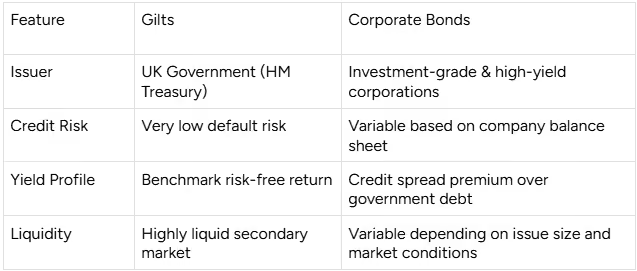
Gilts provide high credit security due to UK sovereign backing. Corporate bonds must offer a premium, or credit spread, over gilts to compensate investors for additional corporate credit risk.
In today’s market, effective fixed-income investing requires evaluating yield relative to counterparty risk. For insights on how modern treasury operations simplify fixed-income allocations, read our report on the return of the all-weather asset class.
How to buy corporate bonds
Institutional investors and corporate treasuries access corporate bonds through several main channels.
Direct OTC trading allows institutions to buy single-name corporate debt through primary issuances or over-the-counter secondary-market desks.
Pooled vehicles such as Money Market Funds (MMFs) and ETFs provide liquidity, but introduce commingled risk and potential tracking discounts during market stress.
Digital treasury infrastructure platforms enable organisations to standardise short-term corporate debt into discrete, single-issuer instruments without omnibus pooling.
Directly managing single-name credit can create administrative overhead and complex bilateral arrangements. Modern platforms help treasurers streamline single-name corporate credit exposure while maintaining standardised settlement and clear reporting.
Streamlining institutional debt allocation
Selecting appropriate debt allocations requires balancing capital preservation with liquidity needs and yield targets. While corporate bonds offer attractive returns, investors must assess individual obligor risk.
TreasurySpring offers direct access to standardised short-term corporate debt, sovereign paper, and bank-secured investments through a single digital platform. Institutional investors can achieve single-obligor exposure without managing complex bilateral agreements.
To learn how your organisation can access investment-grade corporate exposure on a standardised basis, contact TreasurySpring today.
*TreasurySpring’s blogs and commentaries are provided for general information purposes only, and do not constitute legal, investment or other advice.



Subscribe to Insights
Explore flexible, diversified funding, built around your requirements.