

Fed decision: treasury impact summary - September 2026
This commentary follows the FOMC's update and reflects the opinions of TreasurySpring's capital markets experts, Nigel Owen and Olivia Maguire. This does not constitute legal, investment, or other advice.
.png)
- Federal Open Market Committee (FOMC) voted 12-0 to hike rates 25bps
- Dot plot forecasts expect one more hike before year end
- Market expectations diverge from the dot plot in 2027
- Core PCE inflation fell to 2.4% in August
What should we make of the Fed’s decision?
This was the Fed’s first hike in three years, the first move of any sort this year, and only the second unanimous vote from the six meetings so far this year. Kevin Warsh, in his third meeting as Chair of the Fed, came back time and again to doing things, “on a timely basis”. He also mentioned a discipline, not a decision.
The accompanying statement said the action will support a timely return to the committee's 2% goal and, in the press conference, the unanimous vote showed their resolve to achieve price stability on a timelier basis. So in our opinion, it's not if they reach 2%, it's when.
Warsh also repeated a theme he referred to in his Jackson Hole speech, that of his commitment to a monetary policy discipline. He asked not to be judged on that hike, but on the rule of discipline that he follows at every meeting, from here and throughout his chairship.
When asked about the latest inflation print, Warsh said this summer's readings don't tell him that the underlying trends have meaningfully improved, because too many categories were still above 3% on both a 6- and a 12-month basis. He appears to be more about trends than prints, so don’t get hung up on one good or bad print.
And full employment gave the Fed room. The Fed has a dual mandate, that's price stability and full employment, and half the mandate is in line, as jobs numbers are consistent with full employment. We see that as a significant reason why the vote was 12-0.
Why hike now?
As shown in the chart below, the market moved from being 60%-70% expecting a hike to around 90% after August’s inflation numbers. But they actually came in as expected, 3.1% the headline number, 2.4% the core measure, both on a downward trend since peaking in May.
We feel the Fed needed to hike to maintain credibility. This is 65 months of overshoot on the inflation target, and Warsh has been unusually blunt that the responsibility sits squarely with the central bank. So, if they hadn't gone with the hike, you probably would have seen a bigger backup at the long end, because that's where the market prices its doubts.
What should we expect from here?
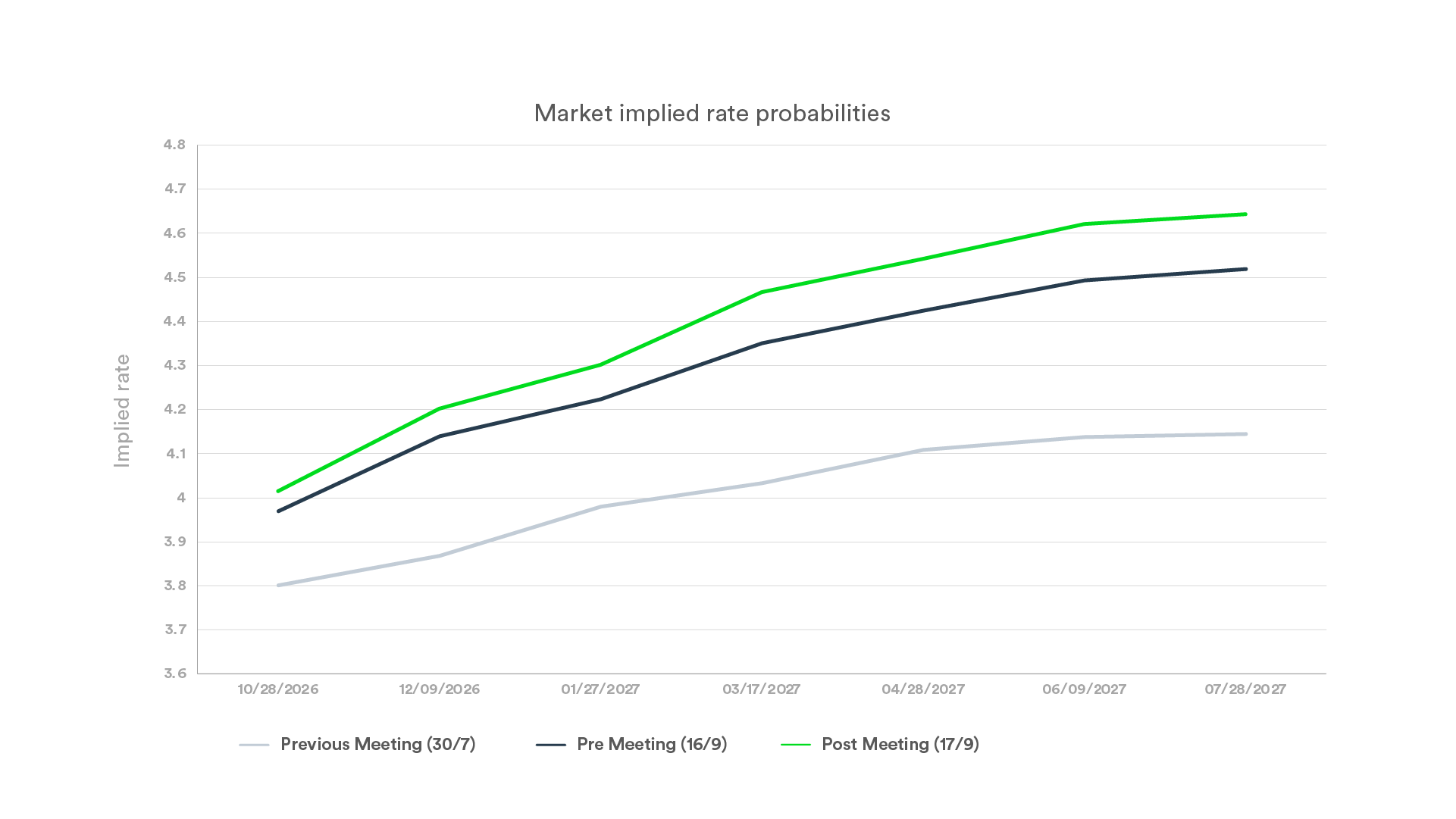
In the 24 hours following the meeting, the market-implied curve shifted up by around 10bps.
The labour market continues to be strong, meaning the focus is likely to remain solely on the inflation half of the Fed’s mandate. Warsh talked about inflation trends, and he mentioned this in a global frame as well. He said most advanced economies are facing price pressures, and that each central bank is making its own judgement consistent with their remits.
There is a consensus between the market and the dot plot for the remainder of this year, with one hike priced in. But beyond that we start to get divergence, not just between the market and the Fed, but within the Fed, too.
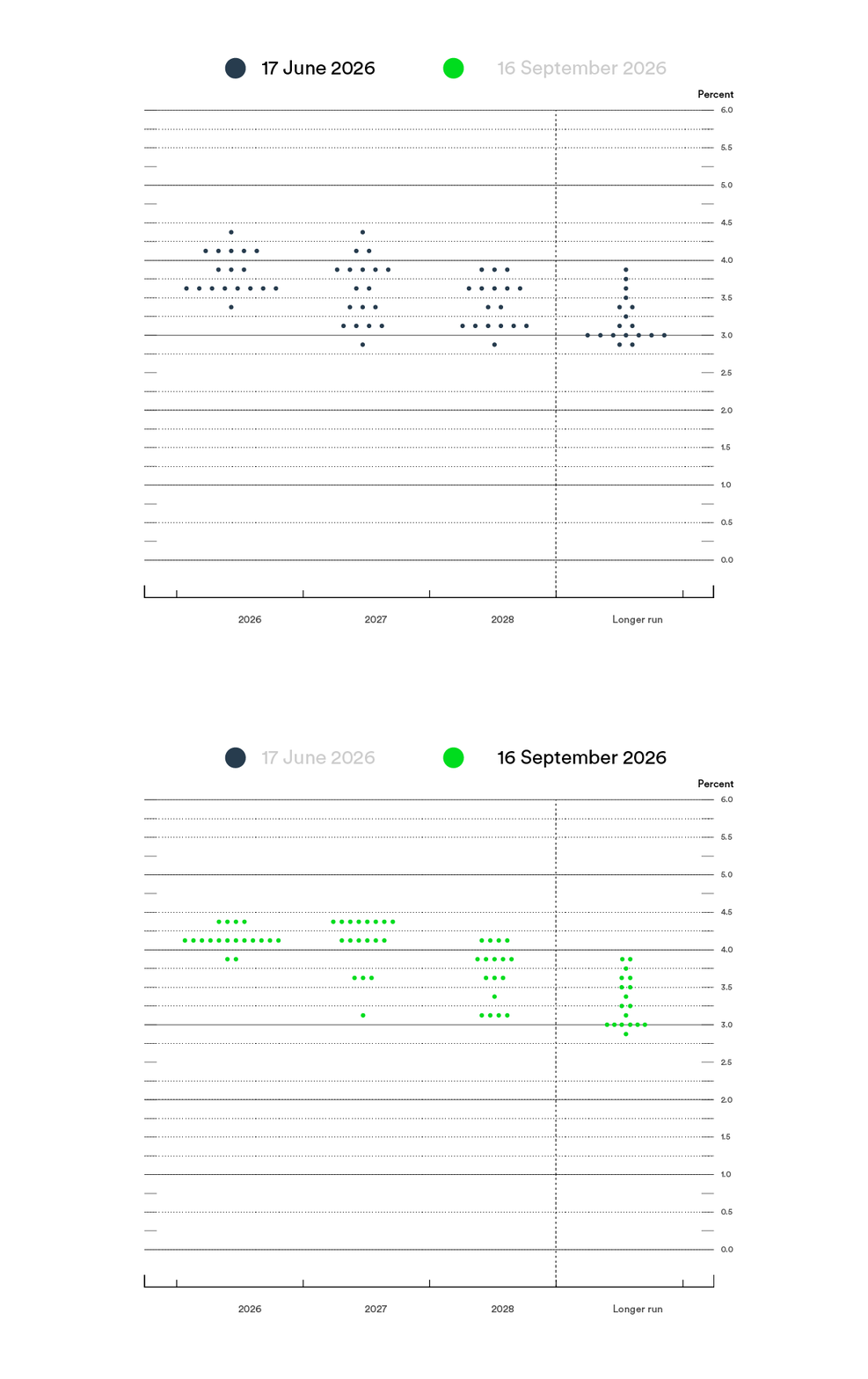
We've seen in recent years that the markets tended to get ahead of the Fed's guidance, whether that's up or down. Monetary policy transmission has lags, and so we think the Fed will need more data to follow those trends that Warsh talked about, which, in our opinion, gives them room to pause at October’s meeting. So our view would be one hike in December, which is in line with the dots.
One other thing to consider is the revamp of how the Bureau of Economic Analysis calculates the PCE inflation measure. There are changes to this index coming in from 30 September, which will be backdated, and some banks have suggested that this will lead to revisions down by as much as 0.2%. Could that delay the next hike?
And for corporate bonds?
The moves that we've seen in government bonds have had little effect on corporate bonds so far. The benchmark rates have made nominal rates attractive for investors, so spreads have widened relatively small amounts, compared to what you might expect. Demand for issuance post the summer holidays has been huge on both sides of the Atlantic. In Europe we've seen a growing number of American companies accessing the euro and sterling markets, with multi-tranche, multi-billion deals. It's an interesting market right now for truly global borrowers out there.
And investors also are wary of those hikes that we've been talking about, buying the highest amount of floating rate notes since 2015 to leave them a little bit of upside should the forecast hikes come through. So we're certainly seeing an impact on the bond market, but so far, for issuers, it's been fairly positive.
*TreasurySpring’s blogs and commentaries are provided for general information purposes only, and do not constitute legal, investment or other advice.
Watch the video



Subscribe to Insights
Explore flexible, diversified funding, built around your requirements.