

Fed decision: treasury impact summary - October 2026
This commentary follows the FOMC's update and reflects the opinions of TreasurySpring's capital markets experts, Nigel Owen and Dr. John Min. This does not constitute legal, investment, or other advice.

This commentary follows the FOMC's update and reflects the opinions of TreasurySpring's capital markets expert, Nigel Owen, and Monex’s Chief Economist, John Min. This does not constitute legal, investment, or other advice.
- Federal Open Market Committee (FOMC) voted 10-2 to hold rates
- Two votes for a hike reflect Committee’s discussion on inflation
- USD has found strength in recent market conditions
- Core PCE inflation up to 3.1% in August, GDP growth 3.4% in Q3
- Strong expectation of a hike in December
What should we make of the Fed’s decision?
This hold was widely expected by the market going into the meeting, with Hammock and Cook voting to hike. The accompanying statement referred to the economy growing at a “strong pace”, which we subsequently saw backed up by the GDP and PCE releases the day after the Fed meeting.
Which raises a valid question: the economy is doing well, inflation is sticky and well above 2%, it has been for the past 5 years, so why wait? What's the advantage of waiting? Warsh doesn’t like signalling, but in not raising this time it feels like has pretty much signalled to the market a hike is coming in December.
However, as the chart below shows, after the last meeting the market was already pricing in a full hike at this meeting, but over the course of the interim period, various comments by Warsh and pieces of data that came out, it fell away to expecting no change going into it.
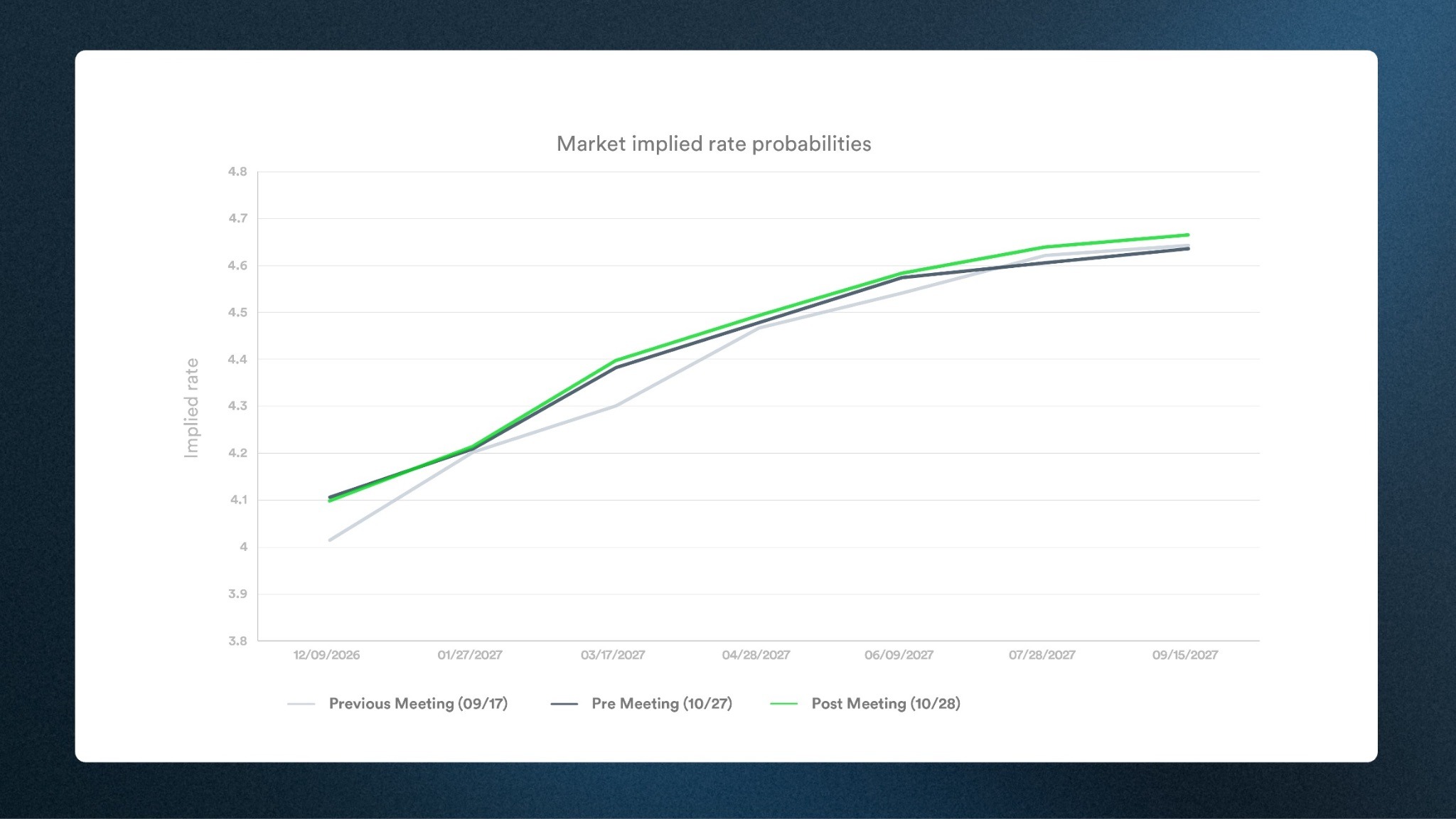
Could they hold again in December?
We believe the hike will happen in December. The risk of not doing so feels too great. The 2-year Treasury, the anchor to the policy rate, was at 4.6% the morning after the Fed meeting. That implies more than two hikes.
A bit like the hike in September, we feel the Fed needs to hike to maintain credibility. However beyond there we have a differing view to the market. We feel the market is pricing a worst-case scenario. We feel we could see just one or even zero hikes next year. This is somewhat based around an assumption of some sort of resolution in the Middle East, but, just as we saw rate expectations drop by around 50 bps when the memorandum of understanding was signed in June, we believe we could see that again if and when we see something similar.
What should we expect from here?
John’s team at Monex did a deep dive into the CPI in the US. It's currently at 3.7% headline, and they attribute about 0.8% of that to the oil shock. So if the Iranian situation gets resolved, and oil drops back to $60-65, then the CPI will go down to about 2.9%. It's not going to go down to 2% unless the US gets rid of its tariffs, which John’s team calculated as adding roughly 0.8%.
So we would still be running at around 3%, and the core PCE for September, with the energy component stripped away, is still running at about 3.1%. Most of that is due to the services, so it's sticky, and therefore as long as wages are holding at 4%, there could be a hawkish case for a second hike early in 2027.
It was also announced that the Fed is moving to seven rate meetings next year and six in 2028, with two strategy meetings. This seems consistent with the fact that he doesn't want to tell us, he wants us to figure things out, which means becoming more data-dependent, rather than listening to Fed members talking.
What has been happening to the dollar?
As you can see in the chart below, the past 12 months overall have been dollar bullish: the dollar has been going up against the major currencies by 5-6%. But there has been a lot of volatility. There was the brief period of the “Sell America” trade, when bonds fell, US equities fell, and the dollar fell. There was a belief that money would leave the US, but that proved temporary, and it came back in the middle of the year. Right now there is around $1.2tr coming into the US for equities and corporate bonds alone: a strong inflow that is supporting the dollar.
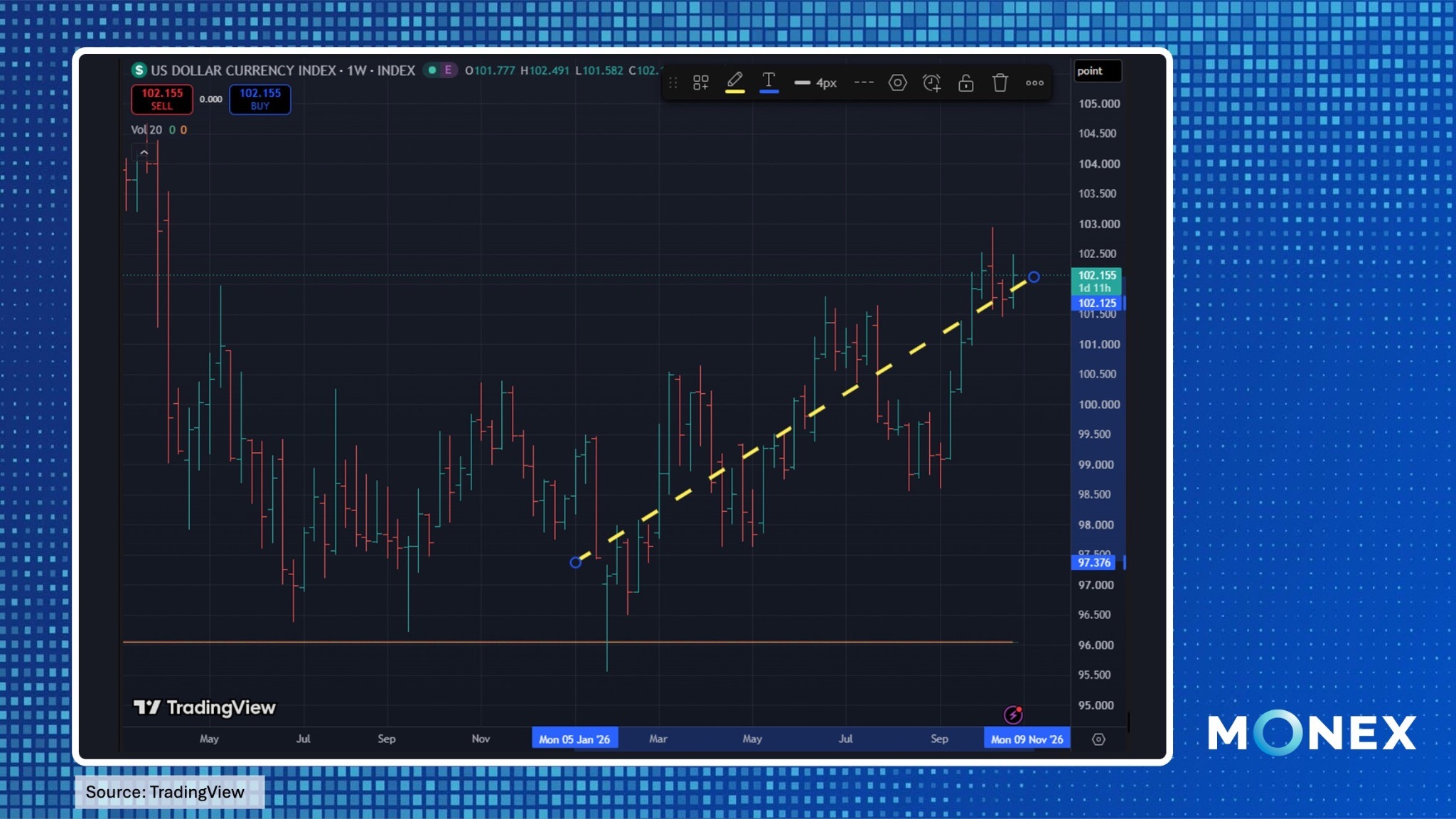
So Monex remains bullish on the dollar for two main reasons.
The first reason is if the oil price stays high that's good for the dollar because you need dollars to buy oil at higher prices globally, so there is a built-in demand.
The second reason is the productivity difference, which kind of translates into interest rate differential. If we think the Fed is going to continue to raise rates, the interest rate differential will work in our favor. In Monex’s analysis, interest rate differential explains about 90% of the currency pair movement so far. So, if you know which way the central bank's gonna move, I think you have a pretty good sense of the direction of the dollar.
And then there are the known unknowns. What is going to happen with France? That could really favour the dollar with a risk-off move away from the euro.that's going to favor the dollar. Another one is whether the AI investment in stocks in the US can maintain enough ROI to justify it. If not, if there is a stock correction in the US, a lot of that money is coming into the United States, from private investors, so that could have an effect the other way.
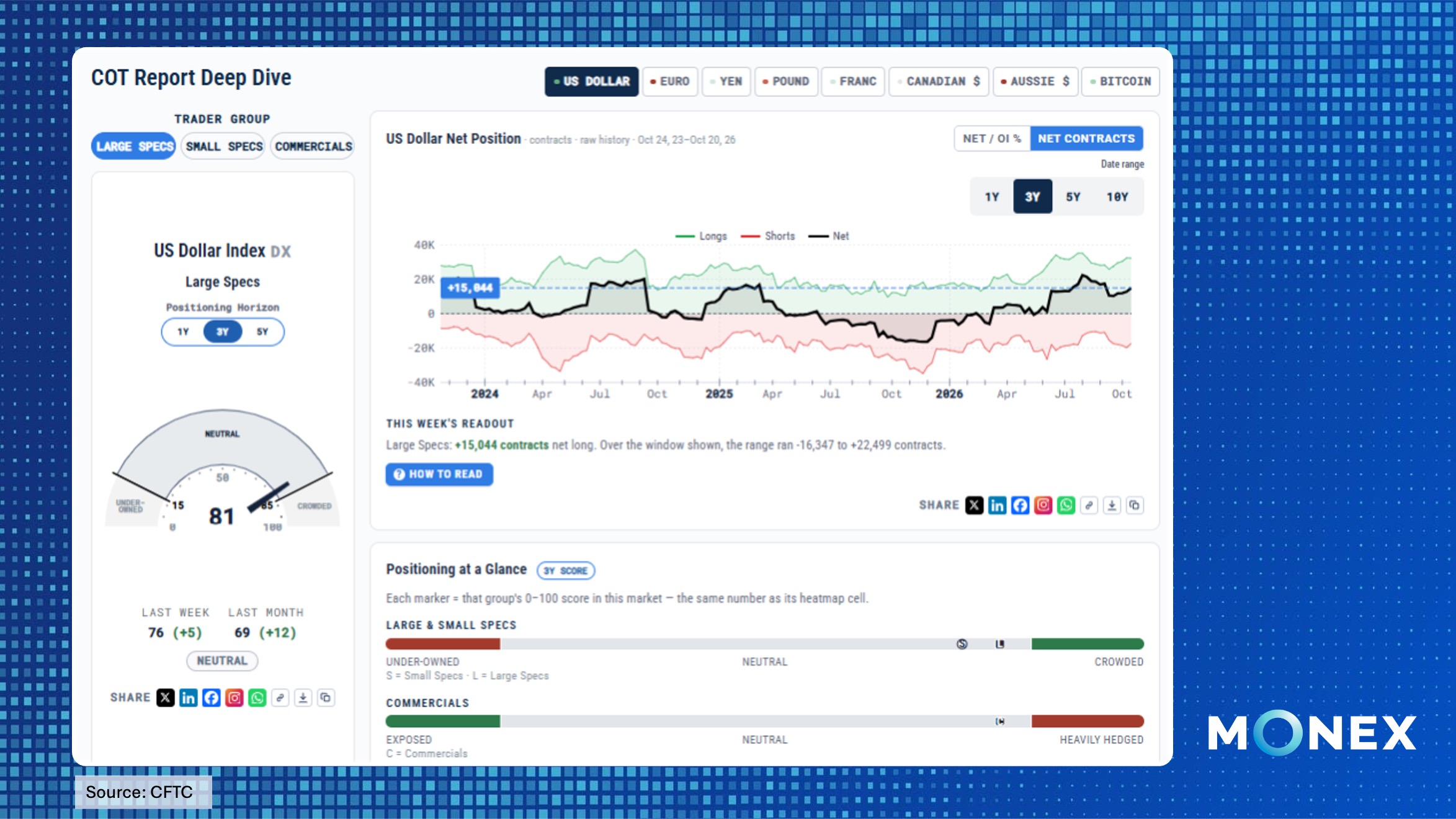
The chart below is from the futures market, and it shows bullishness in the dollar at levels not seen for three years. It is worth considering this when reading the views of analysts on the dollar for the year ahead. These are real trades placed in the market.
What about corporate bonds?
Despite the sell-off we've seen in Treasuries, which has pushed benchmark yields to levels we've not seen in 30 years in some cases, the investment-grade bond market has already set a record for issuance this year, with probably six active weeks left for selling new bonds, which in our opinion will create an interesting dynamic.
We've seen high-yield deals pulled in the last week or two, but, on the whole we expect demand to remain strong for most established issuers in most industries. New names might need to put extra work and extra premium into it, and AI borrowers are likely to need to start paying up or risk feeling some pushback in getting deals fully sold.
*TreasurySpring’s blogs and commentaries are provided for general information purposes only, and do not constitute legal, investment or other advice.
Watch the video



Subscribe to Insights
Explore flexible, diversified funding, built around your requirements.