

Follow the Fed: Treasury impact summary – July 2026
Following a split FOMC vote and stubborn inflation, Nigel Owen and Glen Stone explain why the market is now leaning toward a September hike rather than a cut.
Federal Open Market Committee (FOMC) voted 9-3 for no change
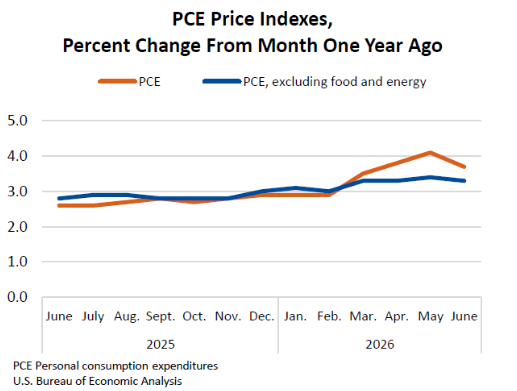
June Core PCE Price Index saw inflation at 3.3%
Treasury yields hit highest levels since 2007

What has the meeting told us?
The 9-3 split vote reflected the dissent that was seen in the market ahead of the meeting. Bets were pricing 8-9, or around 33% chance, of a hike early in the week. Some Wall Street firms were quite forthright in their view that this meeting was where Warsh would set out his stall vs inflation.
The 3.3% Core PCE reading for June means inflation has been above target for five years, and while it was down from 3.4%, the underlying trend continues to be upwards. The Treasury yield curve moved 10bp higher after the meeting, suggesting, in our opinion, that the market doesn’t believe the Fed will tame inflation any time soon.
What was interesting to us in the run up to this meeting was the uncertainty that led to the lack of a consensus view, particularly so close to the meeting. This level of uncertainty is fairly unprecedented and we believe will likely carry forward if Warsh continues to give minimal guidance to the market. The last time we saw such uncertainty was September 2024 when the market was undecided on Powell delivering a 25bp or 50bp cut.
The labour market continues to be strong, meaning the focus is likely to solely remain on the inflation half of the Fed’s mandate.
What happens before the next meeting?
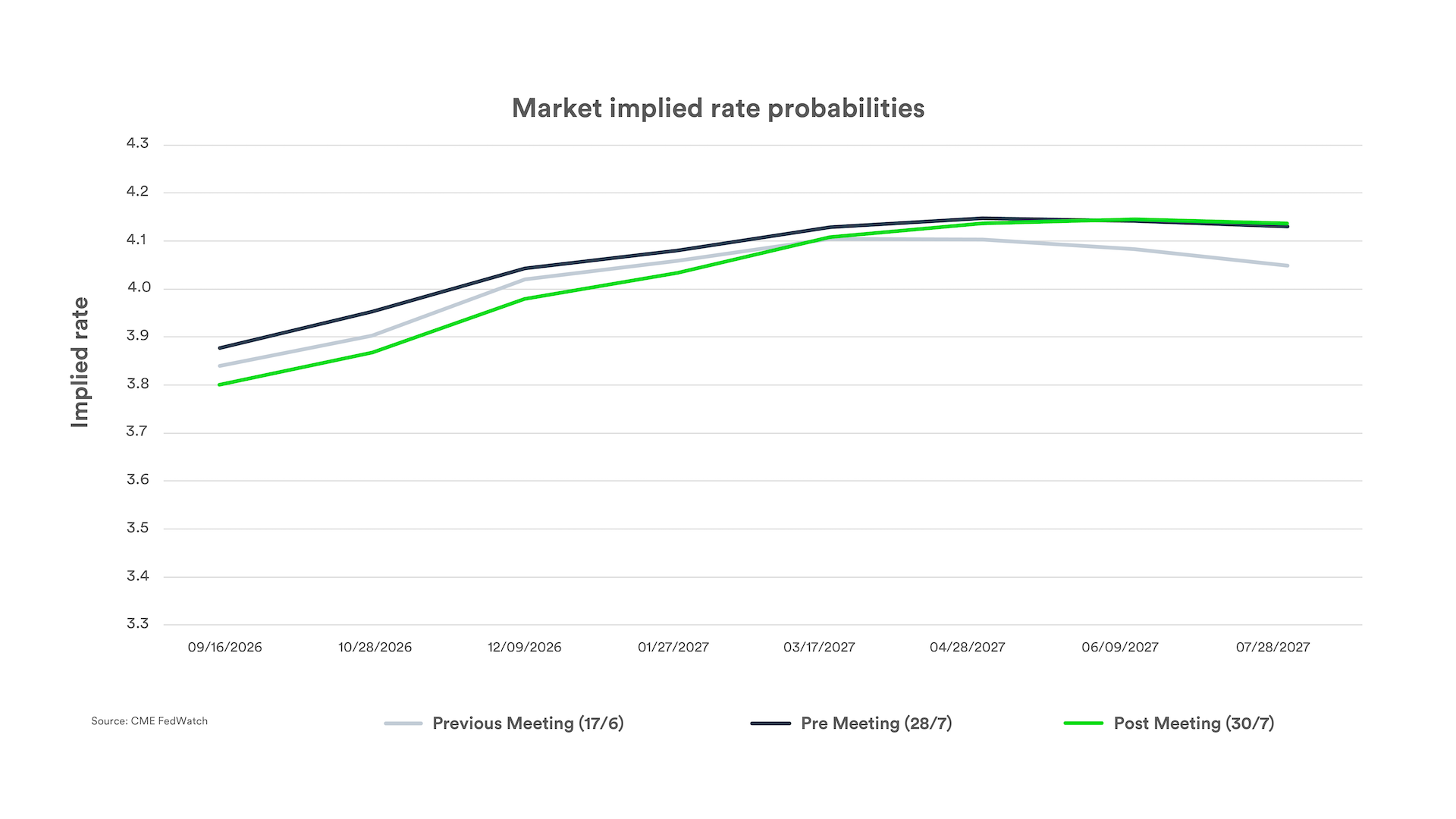
The market has pushed out the first fully-priced hike from September’s meeting to October, a meeting that comes the week before the mid-term elections, which shouldn’t be discounted as impacting on the Fed’s thinking.
We think it’s arguable that the market is already tightening for the Fed - and that will carry through to October. But the action eventually has to catch up with the speak, so we believe it’s highly probable that the hike comes sooner rather than later. The market currently sees a 2 out of 3 chance that hike comes in Sept, but we wonder if it that would have been higher with more guidance. Surely Warsh won’t want to see his credibility questioned so early in his tenure? The move in Treasury yields feels like a clear warning.
Obviously the re-escalation of events in Iran is playing a contributing part to inflation globally, especially as we’re now seeing oil reserves falling too, pushing the price back up. This might mean inflation is transitory in the EU and UK, where there is a more direct impact on energy prices, but in the US it feels like there are more contributing factors which will keep it higher for longer, and thus, once rates are hiked, they’re likely to stay higher for longer too. We’re starting to see a potential divergence in rate pathways between the Fed and other major central banks.
We think September looks like the optimal time to push a hike. It feels important for Warsh’s credibility, but also in advance of the mid-terms where an October hike could have more of a political bearing. The market is pricing an additional 25bp hike in the first half of 2027, but after that there is potential for cuts beyond 2027… but only if the hikes come sooner to get on top of inflation, in our opinion.
*TreasurySpring’s blogs and commentaries are provided for general information purposes only, and do not constitute legal, investment or other advice.


.jpg)
Subscribe to Insights
Explore flexible, diversified funding, built around your requirements.